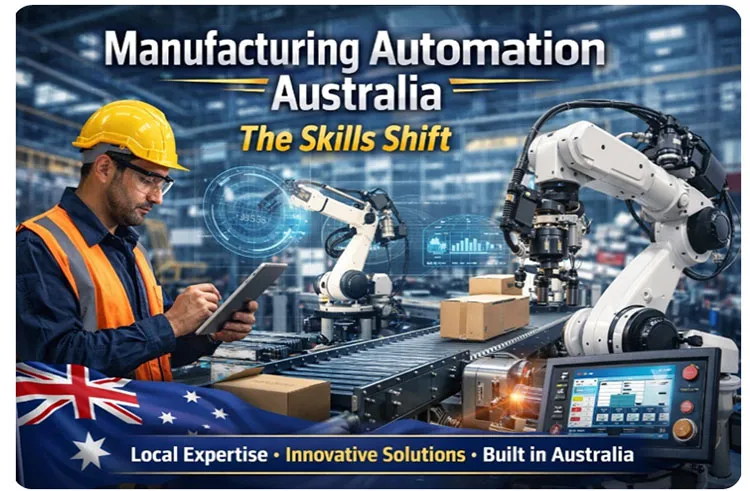
Manufacturing Automation Australia: The Skills Shift

Manufacturing Automation Australia is no longer simply about installing robots or replacing manual labour. It represents a fundamental shift in skills, capability and strategic thinking across Australian industry.
As global competition intensifies, local manufacturers are under increasing pressure to improve productivity, maintain quality, reduce labour risk and operate more efficiently. Automation is the answer — but only when supported by the right local engineering expertise.
This is where the real skills shift is happening.
The Changing Face of Manufacturing Automation Australia
From Manual Processes to Intelligent Automation
Across Australia, manufacturers are transitioning from labour-intensive processes to integrated, intelligent automation systems. Tasks such as palletising, filling, capping, assembly and inspection are increasingly being automated to improve throughput and consistency.
However, modern Manufacturing Automation Australia is no longer limited to standalone machines. Today’s systems integrate robotics, servo control, vision systems, safety platforms and data monitoring into cohesive production environments.
Automation is no longer optional. It is a strategic necessity.
Why Australian Manufacturers Are Investing in Automation
Several factors are driving the surge in Manufacturing Automation Australia:
• Rising labour costs
• Skills shortages in technical roles
• Increased WorkCover and safety risks
• Global price competition
• Demand for shorter production runs and flexibility
For many Australian SMEs, automation is now the only viable pathway to remain competitive while maintaining local production.
Global Competition and Local Productivity Pressures
Australian manufacturers compete in a global marketplace. Imported products often benefit from lower labour costs overseas. To compete, Australian facilities must leverage efficiency, quality and innovation.
Manufacturing Automation Australia enables local businesses to offset labour disadvantages through productivity gains and repeatable quality — but only if systems are designed and supported correctly.
The Skills Shift: What Manufacturing Automation Australia Really Demands
Mechanical, Electrical and Software Integration Expertise
Effective Manufacturing Automation Australia requires multidisciplinary engineering capability. Modern systems combine:
• Mechanical design
• Electrical control systems
• PLC programming
• Servo motion control
• Robotics integration
• Safety compliance
This integration demands highly skilled automation engineers — not just machine installers.
Advanced Robotics, Vision and Control Systems
Robotic palletising, collaborative robots (cobots), automated inspection systems and intelligent conveying are now common in Australian factories.
However, deploying these technologies successfully requires deep application knowledge. Every production line is different. Payloads, speeds, environmental conditions and product variations must all be considered.
The Rise of Multi-Skilled Automation Engineers
The skills shift in Manufacturing Automation Australia is also reshaping the workforce. Engineers are now expected to understand mechanics, electronics, software and robotics together.
This multidisciplinary capability is critical when designing bespoke automation solutions that truly fit the client’s process.
Why Local Expertise Matters in Manufacturing Automation Australia
Understanding Australian Compliance and Safety Standards
Australia has strict safety regulations, including compliance with AS 4024 and other relevant machinery safety standards.
Local automation providers understand these requirements and design systems accordingly. This reduces risk during commissioning and ensures long-term operational safety.
Designing for Australian Operating Conditions
Manufacturing environments in Australia vary widely — from food and beverage facilities to chemical plants and heavy industrial sites.
Temperature, dust, washdown requirements and production variability all impact system design. Local expertise ensures equipment is engineered specifically for Australian conditions.
Faster Support, Service and Ongoing Optimisation
One of the most overlooked aspects of Manufacturing Automation Australia is after-sales support.
When systems are designed and built locally, spare parts, technical support and upgrades are faster and more responsive. Downtime is minimised, and production continuity is protected.
The Risk of Relying Solely on Imported Automation Systems
Limited Local Technical Support
Imported automation systems can offer attractive upfront pricing. However, technical support often relies on overseas teams operating in different time zones.
When production stops, waiting days for remote assistance is not sustainable.
Communication Gaps and Project Delays
Language barriers and distance can result in specification misunderstandings. Minor misinterpretations during design can lead to major delays during installation.
Manufacturing Automation Australia benefits from close collaboration between local engineers and production teams.
Modifications, Upgrades and Spare Parts Challenges
Production evolves. SKUs change. Throughput increases.
Systems designed overseas may not adapt easily to Australian manufacturers’ evolving needs. Local engineering partners can modify and upgrade systems efficiently.
Building Automation Capability Within Australia
Developing Local Engineering Talent
For Manufacturing Automation Australia to remain competitive, investment in local skills is essential. Engineering apprenticeships, graduate programmes and industry partnerships help build the next generation of automation specialists.
Apprenticeships and Industry Collaboration
Strong collaboration between automation companies, manufacturers and technical institutions ensures sustainable skills growth.
Australia’s automation future depends on retaining and developing local talent.
Investing in Long-Term Automation Partnerships
Automation is not a one-off purchase. It is an ongoing partnership.
Manufacturers who work with local automation providers benefit from continuous improvement, system optimisation and future scalability.
How Process Evolution Supports Manufacturing Automation Australia
At Process Evolution, we design and build industrial automation systems locally in Australia, specifically for Australian manufacturers.
Bespoke Automated Machinery Designed and Built Locally
Every facility is different. We specialise in custom-engineered automation solutions tailored to your production process.
Our team integrates mechanical design, electrical engineering, robotics and control systems into cohesive, reliable platforms.
Flexible Capping, Filling and Packaging Automation
From flexible capping machines to automated filling systems and complete packaging lines, we deliver solutions built for performance and adaptability.
Our systems are engineered for changeovers, product variation and long-term scalability.
Robotic Palletising and End-of-Line Solutions
We provide advanced robotic palletising systems designed to reduce manual handling risk and increase throughput.
These solutions are accessible not only to large enterprises but also to small and medium Australian manufacturers seeking productivity gains.
Special Purpose Machines for Unique Manufacturing Challenges
Where off-the-shelf equipment does not exist, we develop special purpose machines to solve complex manufacturing problems.
This capability defines true Manufacturing Automation Australia — innovation driven by local expertise.
The Strategic Advantage of Partnering with a Local Automation Company
Faster Project Execution and Commissioning
Local engineering teams enable quicker site visits, collaborative design reviews and streamlined commissioning.
Reduced Technical Risk Through Collaborative Design
Working closely with your production team during concept and feasibility stages reduces risk and ensures the solution aligns with operational reality.
Long-Term Support Beyond Installation
Our commitment does not end at installation. We provide ongoing service, optimisation and future system upgrades to support your growth.
Future Trends in Manufacturing Automation Australia
Smart Factories and Data-Driven Decision Making
Data collection, performance monitoring and predictive maintenance are becoming integral to Manufacturing Automation Australia.
Smart factories are no longer a future concept — they are being built today.
Collaborative Robotics in Australian SMEs
Cobots are making automation accessible to smaller manufacturers. Their flexibility and safety features allow integration into existing lines with minimal disruption.
Automation as a Tool for Workforce Upskilling
Automation does not eliminate jobs — it transforms them. As repetitive tasks are automated, skilled operators can focus on higher-value activities.
This is the real skills shift.
Manufacturing Automation Australia Is About Capability, Not Just Equipment
Technology Is Only as Good as the Team Behind It
Robots and machines alone do not create competitive advantage. Engineering capability, integration expertise and local support do.
Building Sustainable Competitive Advantage
Manufacturers investing in automation today are building resilience for the future.
Choosing the Right Automation Partner
Selecting a local automation partner with proven engineering capability ensures your investment delivers long-term value.
Final Thoughts: The Future of Manufacturing Automation Australia
Manufacturing Automation Australia is evolving rapidly. The shift is not just towards more machines — it is towards deeper engineering capability, smarter integration and stronger local partnerships.
By investing in local skills, innovation and support, Australian manufacturers can remain globally competitive while strengthening domestic industry.
At Process Evolution, we are proud to contribute to this shift — designing, building and supporting advanced automation solutions right here in Australia.
If you are exploring how Manufacturing Automation Australia can transform your operations, our team is ready to help.
