
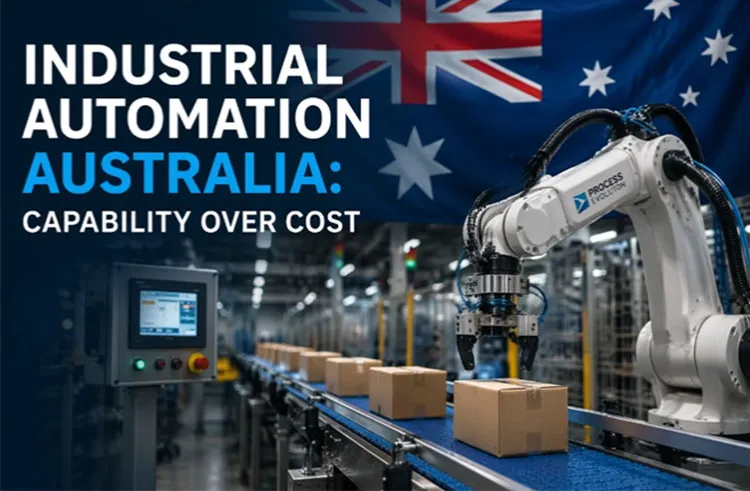
Industrial Automation Australia: Capability Over Cost

Industrial automation in Australia is no longer a future ambition—it’s a present-day necessity. As labour costs rise, workforce availability tightens, and production expectations increase, manufacturers are under pressure to do more with less.
At the centre of this shift is a critical decision: do you prioritise cost, or capability?
For many Australian manufacturers, the answer is becoming clear. The businesses that are thriving are those investing in high-performance, reliable, and scalable automation systems—not simply the cheapest option available.
The State of Industrial Automation in Australia
Why Australian manufacturers are accelerating automation adoption
Across Australia, manufacturers are rapidly adopting industrial automation to stay competitive. Labour shortages, increasing wages, and global competition are forcing a shift towards more efficient, automated production environments.
Automation is no longer just about reducing labour—it’s about:
- Increasing throughput
- Improving consistency and quality
- Reducing reliance on manual processes
- Creating safer working environments
The shift from low-cost labour to high-performance systems
Historically, many businesses relied on labour as a flexible and relatively low-cost solution. That’s no longer viable.
Today, industrial automation in Australia is being driven by performance, not just cost reduction. Businesses are seeking systems that can:
- Run consistently across multiple shifts
- Handle product variability
- Integrate seamlessly with existing processes
- Scale as demand grows
Key industries driving industrial automation in Australia
Industries leading the charge include:
- FMCG and food manufacturing
- Pharmaceuticals and personal care
- Chemicals, coatings, and construction materials
- Contract manufacturing and packaging
These sectors demand precision, repeatability, and efficiency—making automation a critical investment.
Why “Capability Over Cost” Matters More Than Ever
The hidden cost of cheap automation solutions
Low-cost automation can be appealing upfront, but it often comes with hidden costs:
- Limited flexibility
- Poor integration
- Lower build quality
- Minimal local support
What appears cost-effective initially can quickly become expensive when systems fail to perform.
Downtime, inefficiency, and long-term risk
When automation systems are not engineered properly, the impact is immediate:
- Production downtime
- Increased maintenance
- Operator frustration
- Missed output targets
In many cases, businesses end up retrofitting or replacing systems entirely—doubling their investment.
Investing in performance, reliability, and scalability
High-quality industrial automation systems are designed with the bigger picture in mind. They:
- Deliver consistent performance
- Adapt to product changes
- Integrate with upstream and downstream processes
- Provide long-term ROI
This is where capability outweighs upfront cost.
What Defines High-Quality Industrial Automation in Australia
Engineering systems around your specific process
No two manufacturing operations are the same. The best automation solutions are those engineered specifically for your process, not forced into a generic framework.
This includes:
- Understanding product variations
- Analysing workflows and bottlenecks
- Designing systems that align with operational goals
Flexibility vs rigid, off-the-shelf machinery
Standard machines have their place—but they often struggle in environments with:
- Multiple SKUs
- Changing formats
- Variable production requirements
Flexible automation systems allow for:
- Quick changeovers
- Adjustable settings via HMI
- Reduced need for mechanical change parts
Integration across the full production line
True industrial automation goes beyond a single machine. It considers:
- Material flow
- Line balance
- Communication between systems
- Operator interaction
The result is a fully integrated production line, not a collection of disconnected equipment.
Local Expertise: The Advantage of Australian-Based Automation
Faster support, service, and response times
One of the biggest advantages of working with an Australian automation provider is local support.
When issues arise, you need:
- Fast response times
- On-site support when required
- Access to spare parts and technical expertise
Understanding Australian standards and compliance requirements
Industrial automation in Australia must meet strict safety and compliance standards, including:
- AS 4024 machinery safety requirements
- Electrical and control system standards
- Industry-specific regulations
Local providers understand these requirements and design systems accordingly.
Collaboration from concept through to commissioning
Successful automation projects rely on close collaboration. A local partner can:
- Visit your site
- Engage directly with your team
- Adapt designs based on real-world feedback
This leads to better outcomes and smoother project delivery.
From Standard Systems to Fully Bespoke Automation
When a standard system is the right fit
Standard automation systems are ideal when:
- The application is straightforward
- Product variability is low
- Speed and budget are key drivers
They offer a cost-effective entry point into automation.
When bespoke automation delivers greater ROI
For more complex applications, bespoke automation often provides significantly greater value.
This includes scenarios where:
- Multiple product formats are involved
- Space is constrained
- Processes are unique or unconventional
- High levels of precision are required
Scaling from single machines to complete production lines
Automation doesn’t need to happen all at once.
Many manufacturers start with:
- A single machine (e.g. palletiser or filler)
- Then expand into integrated systems
- Eventually moving towards fully automated production lines
Common Automation Opportunities in Australian Manufacturing
End-of-line automation and palletising
Palletising is often one of the easiest and most impactful areas to automate. Benefits include:
- Immediate labour reduction
- Improved consistency
- Reduced manual handling risks
Packaging, filling, and capping systems
Automating packaging processes can significantly improve:
- Throughput
- Accuracy
- Product presentation
Flexible systems are particularly valuable for contract manufacturers handling multiple SKUs.
Reducing manual handling and improving safety
Automation plays a key role in:
- Minimising repetitive tasks
- Reducing workplace injuries
- Improving overall ergonomics
How Process Evolution Delivers Industrial Automation in Australia
A practical, engineering-led approach to automation
At Process Evolution, we take a hands-on, engineering-first approach. Every solution starts with understanding your process in detail before moving into design.
Proven experience across multiple industries
We have experience delivering industrial automation systems across:
- Packaging and processing
- Manufacturing and production
- End-of-line automation
This allows us to apply proven concepts while tailoring each solution.
Designed, built, and supported locally
All systems are:
- Designed in Australia
- Built to suit local conditions
- Supported by a local team
This ensures long-term reliability and peace of mind.
Choosing the Right Automation Partner in Australia
Questions to ask before investing in automation
Before selecting a supplier, consider:
- Do they understand your process?
- Can they demonstrate similar projects?
- Do they offer local support?
- Is the system scalable and flexible?
Red flags when evaluating suppliers
Be cautious of:
- One-size-fits-all solutions
- Limited local presence
- Overpromising without technical detail
- Lack of integration capability
The importance of long-term partnership and support
Automation is not a one-off purchase—it’s a long-term investment. The right partner will:
- Support you beyond installation
- Help optimise performance over time
- Work with you as your business evolves
The Future of Industrial Automation in Australia
Smarter, more flexible manufacturing systems
The future of industrial automation in Australia lies in flexibility and adaptability. Systems are becoming more intelligent and easier to configure.
The role of robotics and advanced control systems
Robotics and advanced control systems are enabling:
- Greater precision
- Faster changeovers
- Improved data visibility
Building resilient, scalable operations
Automation is helping Australian manufacturers build operations that are:
- Less dependent on labour
- More consistent in output
- Better equipped to handle growth
Final Thoughts: Capability Drives Results
Why the cheapest option rarely delivers the best outcome
In industrial automation, the lowest upfront cost rarely delivers the best result. Performance, reliability, and integration are what truly matter.
Focusing on performance, reliability, and ROI
When you invest in capability, you’re investing in:
- Long-term efficiency
- Reduced downtime
- Scalable growth
Taking the first step towards automation
Whether you’re exploring a single machine or a complete production line, the key is to start with the right approach—and the right partner.
If you’re considering industrial automation in Australia, focus on capability first. The results will follow.