
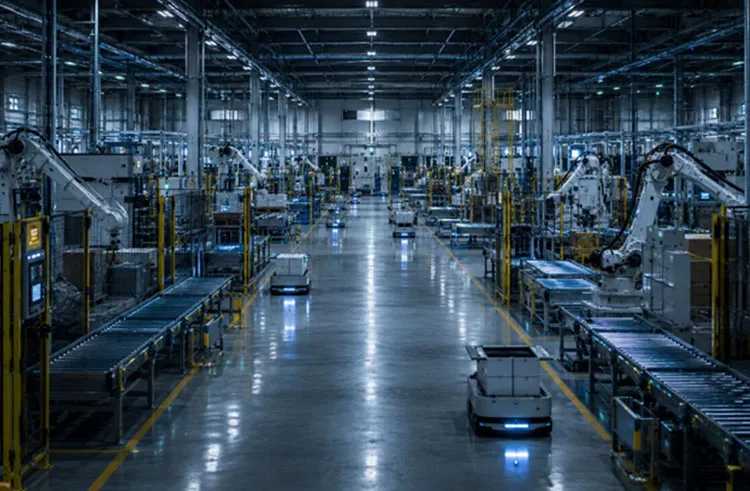
Robotic Automation and the Myth of Lights-Out Factories

The idea of a fully autonomous factory operating without people has captured the imagination of manufacturers for decades. Popularly known as a lights-out factory, this vision suggests a manufacturing facility where robots perform every task, machines communicate seamlessly, and production continues around the clock with little or no human involvement.
While it makes for an impressive headline, the reality is far more nuanced.
Modern robotic automation has transformed manufacturing and continues to unlock significant gains in productivity, quality and efficiency. However, the notion that robots will completely replace people in manufacturing is often misunderstood.
At Process Evolution, we work with manufacturers across Australia to implement practical robotic automation solutions that solve real operational challenges. In our experience, the most successful automation projects are not about eliminating people. They are about enabling people to be more productive, safer and more effective.
What Is a Lights-Out Factory?
A lights-out factory refers to a manufacturing facility that can operate entirely without human intervention.
The term originated from the idea that if no people are present, there is no need for lighting, heating or other amenities designed for workers. In theory, robotic automation systems would perform every task while production continues twenty-four hours a day.
Some highly specialised manufacturing environments have achieved elements of lights-out production. However, these examples are typically limited to very specific applications with highly predictable products, stable processes and minimal variation.
For the vast majority of manufacturers, particularly in Australia, fully autonomous production remains impractical and often unnecessary.
Why the Idea of Lights-Out Manufacturing Is So Appealing
The concept is attractive because it appears to solve many of the challenges facing manufacturers today.
Labour shortages continue to affect businesses across multiple industries. Rising wages, increasing competition and growing demand place pressure on manufacturers to find new ways to improve efficiency.
When viewed from a distance, robotic automation appears to offer a simple solution:
- Eliminate labour challenges
- Increase production capacity
- Improve consistency
- Reduce operating costs
- Operate continuously
While robotic automation can certainly contribute to these outcomes, the reality is that manufacturing remains a complex environment where human expertise continues to play a critical role.
The Reality of Robotic Automation in Manufacturing
Modern robotic automation systems are incredibly capable. Robots can palletise products, assemble components, tend machines, inspect quality, package products and perform countless repetitive tasks with remarkable consistency.
However, manufacturing environments rarely remain static.
Products change.
Customer requirements evolve.
Production schedules shift.
Materials vary.
Unexpected issues arise.
Humans remain exceptionally good at adapting to changing circumstances, solving problems and making decisions based on incomplete information. These are areas where robotic automation still has limitations.
The most successful manufacturing operations recognise that robots and people each have unique strengths.
Rather than replacing people entirely, robotic automation allows businesses to leverage both more effectively.
Common Misconceptions About Robotic Automation
Robots Will Replace Entire Workforces
One of the biggest fears surrounding robotic automation is that it will eliminate jobs.
In reality, most manufacturers adopting automation are not trying to reduce headcount. They are trying to address labour shortages, increase capacity and improve operational performance.
Many Australian manufacturers struggle to recruit and retain employees for repetitive, physically demanding or undesirable tasks.
Robotic automation allows these tasks to be automated while existing employees focus on activities that add greater value to the business.
In many cases, automation enables growth that would otherwise be impossible due to workforce constraints.
Automation Solves Every Problem
Robotic automation is a powerful tool, but it is not a magic solution.
Poor product design, inconsistent processes, unreliable upstream equipment or unclear operational objectives cannot simply be solved by adding a robot.
Successful automation projects begin by understanding the underlying business challenge and designing an appropriate solution.
Technology should support operational goals, not become the goal itself.
Every Process Can Be Automated
Technically, almost any process can be automated.
The more important question is whether it should be.
Some applications deliver exceptional returns from robotic automation. Others may require excessive complexity and investment for limited benefit.
Effective automation focuses on applications where productivity, safety, quality or labour improvements justify the investment.
Where Robotic Automation Delivers the Most Value
Repetitive Manual Tasks
Tasks that require the same action to be repeated thousands of times per day are often ideal candidates for robotic automation.
These activities frequently contribute little value when performed manually and can create fatigue-related quality or safety issues.
Material Handling and Palletising
Material handling remains one of the most common applications for robotic automation.
Robotic palletising systems can stack cartons, bags, containers and products consistently while reducing manual lifting and improving throughput.
For many manufacturers, palletising automation provides one of the fastest and most measurable returns on investment.
Packaging and Assembly Operations
Packaging and assembly processes often involve repetitive movements that are well suited to robotic automation.
These applications can improve consistency, reduce labour requirements and increase production capacity.
Machine Tending Applications
Loading and unloading production equipment is another common area where robotic automation can provide significant benefits.
Machine tending solutions help maximise equipment utilisation while reducing reliance on manual labour.
Why Human Operators and Robots Work Best Together
The future of manufacturing is not about choosing between people and robots.
It is about creating systems where each performs the tasks they do best.
Robots excel at:
- Repetitive tasks
- Heavy lifting
- High-speed operations
- Consistent execution
- Precision movements
People excel at:
- Problem solving
- Decision making
- Adaptability
- Process improvement
- Innovation
When robotic automation is implemented correctly, operators become more productive rather than obsolete.
Instead of spending hours manually palletising products or loading machines, employees can focus on supervision, optimisation, maintenance and continuous improvement activities.
This creates more engaging roles while delivering stronger business outcomes.
Collaborative Robotics and the Future of Manufacturing
One of the most significant developments in recent years has been the rise of collaborative robots, commonly known as cobots.
Unlike traditional industrial robots that often require extensive guarding and dedicated work areas, cobots are designed to operate more closely with people.
This makes robotic automation accessible to a wider range of manufacturers, particularly those with limited floor space or lower production volumes.
Collaborative robotics further reinforces the idea that the future is not lights-out manufacturing. It is people and automation working together more effectively.
Applications such as cobot palletising, machine tending and packaging automation are becoming increasingly common because they offer flexibility, affordability and ease of integration.
The Business Case for Practical Robotic Automation
For most manufacturers, the goal is not to remove people from the factory.
The goal is to improve performance.
Robotic automation can help achieve this by:
- Increasing production capacity
- Reducing manual handling
- Improving product quality
- Enhancing workplace safety
- Reducing labour dependency
- Improving operational consistency
When combined with a clear understanding of production requirements, automation becomes a powerful tool for building more resilient manufacturing operations.
How Process Evolution Approaches Robotic Automation
At Process Evolution, we believe successful robotic automation projects begin with understanding the desired outcome.
Rather than leading with technology, we work with manufacturers to identify bottlenecks, inefficiencies and operational challenges before developing a tailored solution.
Our team designs and builds robotic automation systems locally in Australia, providing complete project delivery from concept development through to commissioning and ongoing support.
Our expertise includes:
- Robotic palletising
- Packaging automation
- Machine tending
- Product handling
- Assembly automation
- End-of-line automation
Because we design and support our systems locally, our clients benefit from faster response times, greater collaboration and long-term technical support.
The Future Is Not Lights-Out Manufacturing
Despite the headlines, the future of manufacturing is unlikely to be completely autonomous.
Instead, the most successful factories will be those that combine the strengths of people with the capabilities of robotic automation.
Manufacturers that embrace this approach can improve productivity, enhance safety, increase quality and create more resilient operations while remaining flexible enough to adapt to future challenges.
The goal should not be to eliminate people from manufacturing.
The goal should be to eliminate inefficiencies.
Partner with Process Evolution for Robotic Automation
If your business is exploring robotic automation, it is important to focus on practical outcomes rather than industry hype.
Whether you are considering palletising automation, machine tending, packaging automation or a broader manufacturing automation strategy, the right solution should support your people, your processes and your long-term business goals.
At Process Evolution, we design, build and support robotic automation solutions locally in Australia, helping manufacturers improve performance while retaining the flexibility that modern production demands.
Contact our team to discuss how robotic automation can help your operation become safer, more productive and more competitive.