
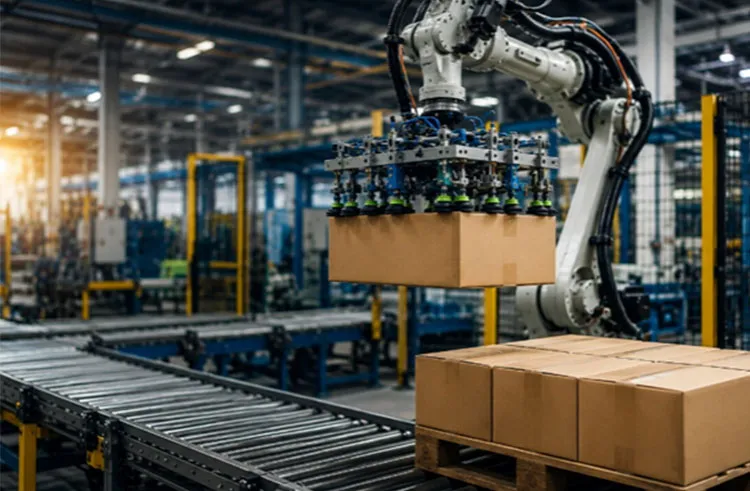
Robotic Automation in Brownfield Factories

For many Australian manufacturers, building a brand-new facility simply is not an option. Instead, they must find ways to increase production, improve efficiency and remain competitive within the constraints of their existing factory. This is where robotic automation can deliver significant value.
While many people associate robotics with large, purpose-built manufacturing plants, the reality is that most automation projects occur within existing facilities. These environments, often referred to as brownfield factories, present unique challenges but also significant opportunities.
At Process Evolution, we specialise in designing and building robotic automation solutions for Australian manufacturers. By combining local engineering expertise with practical manufacturing experience, we help businesses integrate automation into existing operations without the need for costly facility expansions or complete factory redesigns.
Why Robotic Automation Is Transforming Existing Manufacturing Facilities
Australian manufacturers face increasing pressure from rising labour costs, skills shortages, global competition and growing customer expectations. At the same time, many factories are already operating close to capacity and have limited room for expansion.
Robotic automation provides a practical way to increase output, improve consistency and reduce operational bottlenecks without significantly increasing headcount.
Unlike traditional fixed automation, modern robotic systems offer flexibility, adaptability and scalability. They can be integrated into existing production environments, allowing manufacturers to improve performance while continuing to leverage their current equipment and infrastructure.
For many businesses, robotic automation is no longer a future investment. It has become a critical tool for remaining competitive in today’s manufacturing landscape.
What Is a Brownfield Factory?
A brownfield factory is an existing manufacturing facility that is already operational and producing goods.
Unlike a greenfield project, where an entirely new facility is built from the ground up, brownfield projects require automation solutions to be integrated into an existing environment. This often means working around current equipment, established workflows, limited floor space and ongoing production requirements.
Most Australian manufacturers operate brownfield facilities. Whether producing food and beverage products, pharmaceuticals, personal care products, household chemicals, building materials or industrial goods, many companies have invested heavily in their existing infrastructure and need automation solutions that fit within their current operations.
This makes robotic automation particularly attractive, as robots can often be integrated into existing production lines with minimal disruption.
The Benefits of Robotic Automation in Brownfield Environments
Increasing Production Without Expanding Floor Space
One of the biggest advantages of robotic automation is the ability to increase throughput within an existing footprint.
Many manufacturers assume that increasing production requires additional factory space. However, robotic systems can often be designed to operate within compact areas, allowing businesses to maximise the utilisation of their existing facilities.
By optimising material flow, reducing manual handling and improving process efficiency, robotic automation can significantly increase output without requiring costly building extensions.
Reducing Reliance on Manual Labour
Labour shortages continue to challenge manufacturers across Australia.
Tasks such as palletising, machine loading, product handling, packaging and assembly can be repetitive, physically demanding and difficult to staff consistently.
Robotic automation allows these activities to be performed reliably and efficiently while enabling employees to focus on higher-value responsibilities that require human judgement, problem-solving and technical expertise.
Improving Consistency, Quality and Traceability
Human performance naturally varies throughout a shift. Fatigue, distractions and repetitive tasks can all impact consistency.
Robotic automation delivers repeatable performance, ensuring products are handled, assembled, packaged or palletised the same way every cycle.
This improved consistency often results in:
- Reduced product damage
- Fewer quality defects
- Improved process control
- Greater traceability
- Reduced waste
For manufacturers operating in regulated industries, these benefits can be particularly valuable.
Enhancing Workplace Safety and Ergonomics
Many manufacturing tasks involve repetitive movements, awkward postures, heavy lifting or hazardous environments.
Robotic automation can help remove employees from these activities, reducing injury risks while improving workplace ergonomics.
Applications such as robotic palletising, machine tending and material handling are commonly implemented to improve safety outcomes while simultaneously increasing productivity.
Creating Scalable Manufacturing Operations
As demand increases, manufacturers need systems that can grow with their business.
Modern robotic automation solutions can often be adapted to accommodate new products, increased production volumes and changing operational requirements.
This scalability helps protect the initial investment while providing a pathway for future growth.
Key Challenges When Implementing Robotic Automation in Existing Factories
While robotic automation offers significant benefits, successful implementation requires careful planning.
Limited Available Floor Space
Brownfield facilities are rarely designed with future automation in mind.
Equipment, walkways, storage areas and utility services can restrict the available space for new systems.
Successful robotic automation projects require creative engineering solutions that maximise functionality while minimising the footprint.
Integrating with Legacy Equipment
Many manufacturers operate equipment that has been in service for decades.
Integrating modern robotic automation with older machinery can be challenging and requires experienced engineers who understand both legacy systems and current automation technologies.
Effective integration is often the difference between a successful project and an expensive headache.
Maintaining Production During Installation
Production downtime can be costly.
For this reason, robotic automation projects must often be designed, built and tested in a manner that minimises disruption to existing operations.
Careful planning, off-site testing and staged implementation strategies can help manufacturers continue operating while upgrades are being completed.
Managing Safety Requirements and Compliance
Every robotic automation project must comply with relevant Australian safety standards and risk management requirements.
This includes machine guarding, safety systems, risk assessments and operator interactions.
Safety should never be an afterthought. It must be considered from the earliest stages of system design.
Robotic Automation Applications in Brownfield Factories
The versatility of robotic automation makes it suitable for a wide range of manufacturing applications.
Robotic Palletising and End-of-Line Automation
One of the most common applications is robotic palletising.
By automating the stacking of cartons, bags, containers or packaged products, manufacturers can improve throughput, reduce manual handling and create more consistent pallet loads.
Robotic palletising systems are often among the fastest automation projects to deliver measurable returns.
Machine Tending and Manufacturing Support
Robots can be used to load and unload CNC machines, moulding machines, processing equipment and production machinery.
Machine tending applications help maximise equipment utilisation while reducing labour requirements and improving production consistency.
Automated Assembly and Product Handling
Robotic systems can perform assembly operations, component placement, product transfers and handling tasks with exceptional accuracy and repeatability.
These applications are particularly valuable where product quality and consistency are critical.
Packaging and Material Handling
Packaging operations often involve repetitive manual tasks that are ideally suited to robotic automation.
Applications may include:
- Case packing
- Product loading
- Carton handling
- Pick-and-place operations
- Material transfer
These systems can improve productivity while reducing workplace fatigue and injury risks.
Inspection and Quality Control
Robotic automation can also be combined with machine vision technologies to inspect products, verify assembly processes and identify defects.
This improves quality control while reducing the risk of defective products reaching customers.
Why Every Robotic Automation Project Requires a Different Approach
No two factories are the same.
Each facility has unique products, processes, production goals, equipment layouts and operational challenges.
For this reason, successful robotic automation projects begin with understanding the desired outcomes rather than simply selecting a robot.
The most effective solutions are designed around the specific needs of the business, ensuring the technology supports operational objectives rather than forcing operations to adapt to the technology.
This approach often delivers better performance, higher adoption rates and stronger long-term returns.
The Importance of Local Engineering Expertise
Choosing the right automation partner is just as important as choosing the right technology.
Many manufacturers discover that purchasing equipment is only one part of a successful automation project. Ongoing support, service, optimisation and troubleshooting are equally important.
Working with a local Australian automation company offers several advantages:
- Faster support response times
- Local engineering expertise
- Understanding of Australian standards
- Easier collaboration throughout the project
- Long-term service and maintenance support
When production is critical, having access to local expertise can make a significant difference.
How Process Evolution Delivers Robotic Automation Solutions
At Process Evolution, we design and build robotic automation solutions specifically for Australian manufacturers.
Our team works closely with clients to understand their production challenges, identify improvement opportunities and develop practical automation systems that integrate into existing operations.
We provide complete project delivery, including:
- Concept development
- Engineering design
- Mechanical design
- Electrical design
- Control systems
- Robot programming
- Manufacturing and assembly
- Installation and commissioning
- Training and support
Unlike overseas equipment suppliers, we provide ongoing local support from engineers who understand the system because they helped design and build it.
Our experience across robotic palletising, packaging automation, machine tending, assembly automation and end-of-line automation enables us to develop solutions that deliver real operational improvements.
Is Robotic Automation Right for Your Factory?
If your operation relies heavily on repetitive manual tasks, experiences labour challenges, struggles to increase output or faces safety concerns, robotic automation may offer significant benefits.
The best place to start is by identifying processes that are repetitive, labour-intensive or create production bottlenecks.
A well-designed robotic automation solution can improve productivity, consistency, safety and profitability while helping future-proof your manufacturing operation.
Partner with Process Evolution for Robotic Automation
As Australian manufacturers continue to face increasing pressure to improve efficiency and remain competitive, robotic automation is becoming an essential part of modern manufacturing strategy.
Whether you are looking to automate palletising, packaging, assembly, machine tending or material handling processes, the right solution can unlock significant productivity improvements within your existing facility.
At Process Evolution, we combine local engineering expertise with practical manufacturing experience to deliver robotic automation solutions that work in real-world production environments.
If you are considering robotic automation for your factory, contact Process Evolution to discuss how we can help modernise your operation and support your long-term growth.