
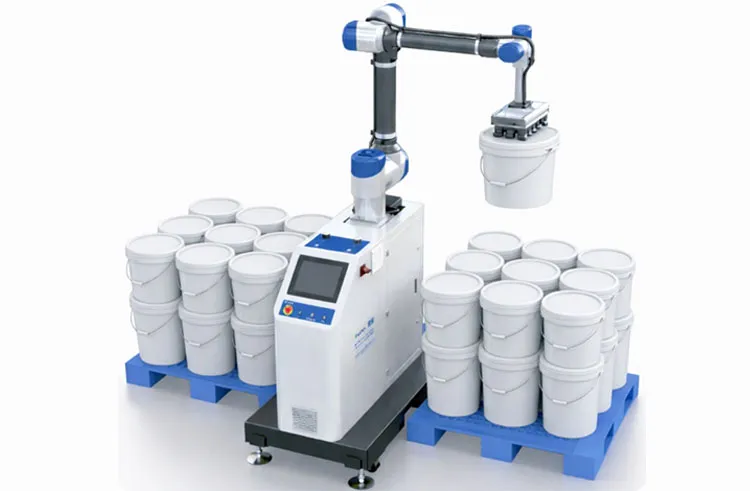
Palletising Automation Solutions for Modern Manufacturing

In modern manufacturing, efficiency at the end of the production line is just as important as efficiency at the beginning. One of the most common bottlenecks in many factories is manual palletising — the repetitive process of stacking finished products onto pallets ready for storage or transport.
This is why palletising automation is becoming an essential part of modern manufacturing operations. Automated palletising systems allow businesses to move products onto pallets faster, more consistently and with significantly less manual handling.
At Process Evolution, we design and build palletising automation solutions locally in Australia for manufacturers across a wide range of industries. From flexible cobot palletisers to heavy-duty palletising workhorses, the right solution can dramatically improve productivity, safety and reliability at the end of your production line.
Why Palletising Automation Is Becoming Essential in Modern Manufacturing
Across Australia, manufacturers are facing several challenges that make palletising automation increasingly attractive.
Rising labour costs and labour shortages
Manual palletising is physically demanding work that can be difficult to staff consistently. Labour shortages across many sectors mean manufacturers are struggling to find and retain workers willing to perform repetitive palletising tasks.
Automated palletising systems help businesses reduce their reliance on manual labour while maintaining consistent output.
Manual palletising creates safety and consistency issues
Repeated lifting of cartons, pails or bags can lead to workplace injuries, particularly back and shoulder strain. Manual stacking can also lead to inconsistent pallet patterns, unstable loads and product damage during transport.
Palletising automation removes much of the heavy lifting from operators while ensuring products are stacked in stable and repeatable pallet patterns.
Manufacturers need more flexible end-of-line systems
Many production environments now run multiple product formats, different carton sizes and frequent product changeovers. Automated palletising systems can be designed to handle these variations with minimal operator intervention.
This flexibility is one of the key reasons palletising automation is rapidly being adopted across food, beverage, personal care, chemical and industrial manufacturing sectors.
What Is Palletising Automation?
Put simply, palletising automation refers to the use of robotic or automated systems to stack finished products onto pallets in a consistent and repeatable way.
These systems are typically installed at the end of a production line and integrate with conveyors or packaging equipment.
How palletising automation works in a production environment
Products move down a conveyor after packaging or filling. The automated palletising system then picks each item and places it onto a pallet according to a programmed pallet pattern.
Once the pallet is full, it can be removed by forklift or pallet transfer system and replaced with an empty pallet ready for the next cycle.
Common products handled by palletising systems
Palletising automation is used across many industries to handle products such as:
• Cartons and boxes
• Plastic containers and bottles
• Pails and buckets
• Bags of powder or granules
• Trays and packaged goods
The exact system design depends heavily on the product weight, shape and production speed.
The difference between manual palletising and automated palletising
Manual palletising relies entirely on human labour, which can be inconsistent and physically demanding.
Automated palletising systems, by contrast, can operate continuously with predictable performance, ensuring each pallet is built consistently and safely.
The Main Types of Palletising Automation Systems
Not all palletising automation systems are the same. Different production environments require different levels of flexibility, speed and payload capability.
Industrial palletising systems for high-speed and heavy-duty applications
Traditional industrial palletising robots are often used in high-speed environments where large volumes of product must be handled continuously.
These systems are capable of handling heavier loads and higher throughput but typically require larger footprints and more complex safety infrastructure.
Cobot palletising systems for flexible and compact operations
Collaborative robots, or cobots, have become increasingly popular for palletising automation in recent years.
A cobot palletising system is ideal for operations that require flexibility, compact footprints and relatively straightforward integration into existing production lines.
These systems are commonly used for:
• Carton palletising
• Smaller product loads
• Multiple product formats
• Moderate production speeds
Because cobots are relatively easy to program and redeploy, they can be a practical entry point into palletising automation.
Purpose-built palletising systems for repeatable end-of-line tasks
In some applications, a dedicated palletising system designed specifically for palletising can provide greater reliability and performance than a standard collaborative robot.
This is where purpose-built palletising systems come into play.
When a Bespoke Palletising Solution Makes the Most Sense
While standard palletising systems can handle many applications, some manufacturing environments require bespoke palletising automation designed specifically for their products and production lines.
Products with unusual shapes, weights or handling requirements
Products that are unstable, irregularly shaped or particularly heavy often require custom gripper designs and specialised handling systems.
Lines with limited floor space or difficult layouts
Older factories or complex production lines often have space constraints that require carefully engineered automation solutions.
Applications requiring integration with existing equipment
A bespoke palletising system can be designed to integrate seamlessly with existing filling lines, packaging equipment or conveyors.
At Process Evolution, many of the palletising automation systems we build are engineered specifically around the customer’s production environment.
Where Cobot Palletising Systems Work Best
A cobot palletiser can be an excellent solution for many manufacturing operations.
Low to medium throughput production lines
Cobot palletisers typically perform best in applications where production speeds are moderate and product weights fall within the payload capacity of collaborative robots.
Operations with multiple product formats and changeovers
Because cobots are easy to reprogram, they are ideal for environments where pallet patterns or product sizes change frequently.
Manufacturers wanting an accessible entry point into automation
For businesses new to automation, a cobot palletising system can provide a practical first step towards automated production.
Introducing the AWP: A Palletising Workhorse Built for the Job
While cobots offer flexibility, some palletising applications require a system designed specifically to perform palletising tasks continuously and reliably.
This is where purpose-built palletising platforms such as the AWP palletising system come into play.
Why the AWP looks similar to a cobot palletising system
From the outside, an AWP palletising system can appear similar to a cobot palletiser. Both use robotic arms to pick and place products onto pallets.
However, the engineering behind the system is designed specifically for palletising performance.
How the AWP differs from a standard collaborative robot
Unlike general-purpose collaborative robots, the AWP is engineered as a dedicated palletising platform with characteristics that make it particularly effective in palletising environments.
These systems typically offer:
• Higher payload capability
• Greater rigidity and speed
• Dedicated palletising software
• Robust industrial construction
Where an AWP-style palletising system is the better fit
AWP palletising systems are particularly suited to applications where products are heavier or where palletising must occur consistently over long production runs.
For many manufacturers, these systems provide a reliable and efficient palletising solution without the complexity of larger industrial robotic cells.
The Value of Local Australian Design, Build and Support
When investing in palletising automation, the quality of engineering support behind the system is just as important as the hardware itself.
At Process Evolution, our palletising automation solutions are designed and supported locally in Australia.
Why local engineering knowledge matters
Every manufacturing environment is different. Local engineers who understand Australian manufacturing conditions can design systems that are practical, reliable and easier to maintain.
Faster support and practical problem solving
Working with a locally based automation partner means faster support, clearer communication and solutions that are tailored to your production environment.
Building palletising automation for Australian manufacturers
Our team specialises in designing and building palletising automation systems that integrate seamlessly into real-world manufacturing operations.
Finding the Right Palletising Automation Solution for Your Operation
There is no single palletising system that suits every application.
The right solution depends on factors such as product type, pallet patterns, throughput requirements and available space.
Whether the best approach is a cobot palletiser, a bespoke palletising system, or a dedicated AWP palletising workhorse, the key is selecting a solution designed specifically for your operation.
At Process Evolution, we help manufacturers evaluate their palletising requirements and design systems that deliver reliable performance for years to come.
For many businesses, investing in palletising automation is one of the most effective ways to improve productivity, enhance safety and future-proof their manufacturing operations.