
Cobot Palletiser Applications That Actually Work

The Rise of the Cobot Palletiser in Modern Manufacturing
Collaborative robots are rapidly transforming end-of-line packaging operations. A cobot palletiser offers a flexible, cost-effective way for manufacturers to automate repetitive palletising tasks without the complexity of traditional industrial robots.
Across Australia, manufacturers are facing increasing pressure from:
• Rising labour costs
• Labour shortages
• Workplace safety concerns
• Increasing production demands
A cobot palletiser solves many of these problems by automating the physical task of stacking cartons, containers or bags onto pallets with consistent accuracy.
At Process Evolution, we design and build locally engineered cobot palletising systems that are specifically tailored to Australian manufacturers.
What Is a Cobot Palletiser?
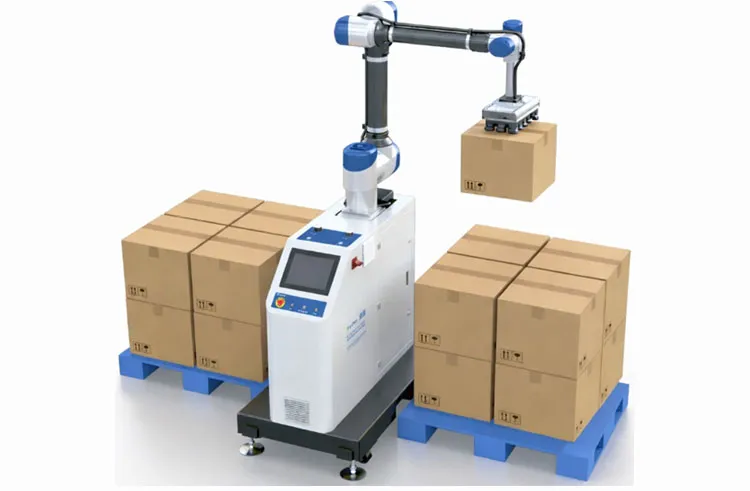
A cobot palletiser is a robotic palletising system built around a collaborative robot. Unlike traditional industrial robots, collaborative robots are designed to safely operate near people and require significantly less infrastructure.
Typical components of a cobot palletising system include:
• Collaborative robot arm
• Palletising software
• End-of-arm gripper
• Conveyor interface
• Safety systems
• Pallet detection and positioning
Because cobots are easier to deploy and program, they are particularly suited to small and medium-sized manufacturing operations that require flexibility.
Why Cobot Palletising Is Gaining Popularity in Australia
Labour Challenges in Manufacturing
One of the main drivers behind cobot palletiser adoption is the increasing difficulty of recruiting reliable labour for repetitive manual palletising tasks.
Manual palletising often involves:
• Repetitive lifting
• Fatigue-related errors
• Workplace injuries
• Inconsistent stacking quality
A cobot palletiser performs the same task consistently across every shift.
Improved Workplace Safety
Manual palletising is one of the most common sources of workplace injuries in manufacturing environments.
Common risks include:
• Back injuries
• Repetitive strain injuries
• Dropped cartons
• Fatigue-related incidents
By automating the lifting and stacking process, a cobot palletiser can significantly reduce these risks.
Flexible Automation for Changing Production
Many manufacturers run multiple SKUs, carton sizes or packaging formats.
A well-designed cobot palletiser allows operators to easily switch between pallet patterns and product types without major changeovers.
This makes cobot palletising particularly suitable for industries such as:
• Food and beverage manufacturing
• Personal care and cosmetics
• Household chemicals
• Contract manufacturing
• Industrial products
Cobot Palletiser Applications That Actually Work
Not every palletising application suits a cobot. However, when applied correctly, a cobot palletiser can deliver outstanding results.
Below are some of the most successful applications we see in real manufacturing environments.
Carton Palletising for End-of-Line Packaging
One of the most common applications for a cobot palletiser is stacking cartons at the end of a packaging line.
Typical examples include:
• Cosmetic product cartons
• Household chemical boxes
• Food packaging cartons
• Pharmaceutical products
In these applications, a cobot palletiser can reliably stack cartons onto pallets with consistent alignment and stable pallet patterns.
Pail and Bucket Palletising
Many manufacturers package products into pails or buckets ranging from 2L to 20L.
Manual palletising of filled pails is physically demanding and often inconsistent.
A cobot palletiser can:
• Pick filled pails directly from conveyors
• Place them into stable pallet patterns
• Maintain consistent pallet quality
• Reduce manual lifting
For manufacturers filling products such as paints, adhesives, coatings or food ingredients, this can be a highly effective automation solution.
Multi-SKU Palletising
Manufacturers running multiple product formats often struggle to justify traditional palletising automation.
A cobot palletiser can be programmed to handle multiple palletising recipes, allowing operators to switch between:
• Different carton sizes
• Different pallet patterns
• Different product lines
This flexibility makes cobot palletising particularly valuable for contract manufacturers and businesses with frequently changing production runs.
Low to Medium Throughput Palletising
Cobot palletisers are particularly well suited to operations where throughput requirements are moderate.
Typical production rates include:
• 6–12 cartons per minute
• 10–20 kg payloads
• Single or dual pallet stations
In these scenarios, a cobot palletiser can provide a highly cost-effective automation solution without the complexity of large industrial palletising cells.
When a Cobot Palletiser Is Not the Right Solution
While cobot palletisers offer many advantages, they are not suitable for every application.
High-speed palletising environments often require:
• Traditional industrial robots
• Layer palletising systems
• High-speed gantry palletisers
At Process Evolution, we assess each application carefully to ensure the right automation technology is selected.
Sometimes the correct answer is not a cobot palletiser.
Why Local Engineering Support Matters
Automation equipment is a long-term investment. Choosing a system supported by local engineering expertise is critical.
At Process Evolution, our palletising systems are:
• Designed locally in Australia
• Built by experienced automation engineers
• Supported by local technicians
• Customised for Australian manufacturing environments
This ensures our customers receive ongoing support long after installation.
Designing a Cobot Palletiser That Actually Works
A successful cobot palletising project involves far more than simply placing a robot next to a conveyor.
Critical engineering considerations include:
• Product stability
• Gripper design
• Pallet patterns
• Line integration
• Safety systems
• Throughput requirements
Our team at Process Evolution specialises in designing palletising systems that integrate seamlessly into existing production lines.
Is a Cobot Palletiser Right for Your Manufacturing Operation?
Every manufacturing operation is different.
The best way to determine whether a cobot palletiser is suitable is to evaluate factors such as:
• Product type
• Carton weight
• Production rates
• Available floor space
• Pallet configurations
A properly designed system can often deliver strong returns through:
• Labour savings
• Increased reliability
• Improved workplace safety
Cobot Palletising Solutions Built in Australia
Process Evolution designs and builds advanced palletising automation systems for manufacturers across Australia.
Our systems are engineered to deliver:
• Reliable palletising performance
• Flexible product handling
• Simple operator interaction
• Long-term service support
If you are considering automation for your end-of-line palletising operations, a cobot palletiser may be an excellent place to start.